Welcome to this self-guided art tour at The Tallison hotel.
Your journey begins as most stays do – at the Front Desk.
Front Desk
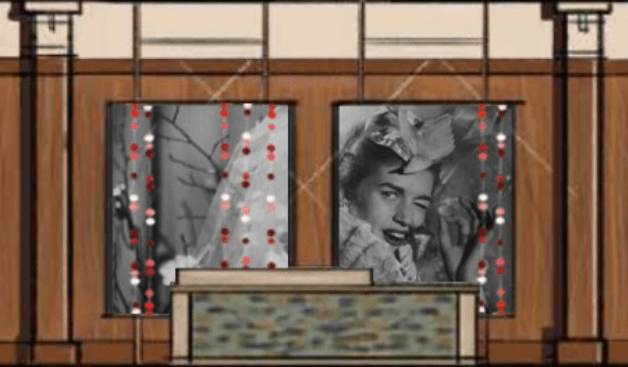
Meet Avriel Shull, a self-taught architectural designer from Carmel, Indiana, celebrated for her iconic mid-century modern style. Avriel, who married an Indianapolis columnist, successfully arranged to have her wedding featured in Life magazine in 1951. You’re viewing a photo from that spread featuring Avriel wearing a stunning satin wedding gown she designed and sewed herself.
The addition of strung spherical elements by Atlanta artist Tommy Moss enhances this large-scale split portrait with dimension, color, and interest, symbolizing the ‘Circle Circle’ and Carmel’s roundabouts. This artwork creates an overall striking focal point, spanning the two panels behind the reception desk, while adding a captivating and engaging visual element to the hotel’s design.
Vyne Restaurant & Bar
Inside the restaurant at the banquette and back bar, you’ll see two arrangements of work by Charles Bretzman and John Johnson.
At the dawn of the 1900s, the Bretzman Photo Company, AKA the Bretzman Studio, emerged in Indianapolis, where Charles Bretzman became a respected portrait and commercial photographer for over thirty years. Along with running his own studio, he captured the essence of early 20th century Indianapolis and showcased notable figures as a staff photographer for three local newspapers. Charles even held the position of first official photographer for the iconic Indianapolis 500-mile automobile race!
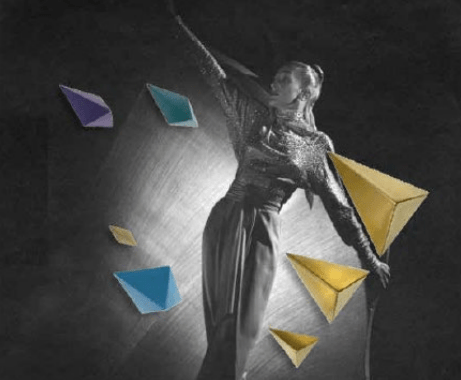
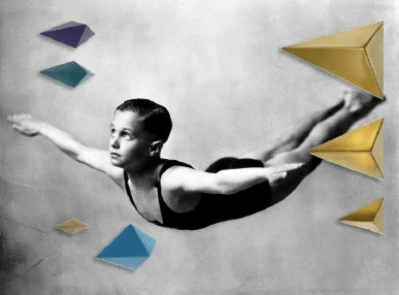
A breathtaking black-and-white photo from the Bretzman Studio features a stunning dancer in a dynamic pose, creating a memorable impression sure to captivate patrons of the restaurant and bar. Three-dimensional jewel-like sculptures by local artist, John Johnson, are attached to the artwork from behind, adding a layer of interest and dynamism for guests to enjoy while sitting at the restaurant bar.
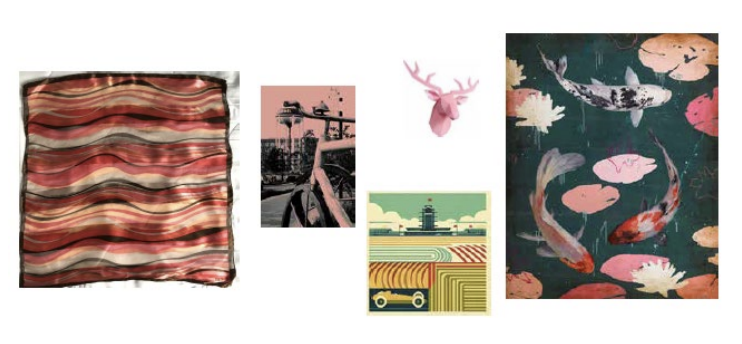
This wall is a feast for the eyes!
Notable Features:
- A framed scarf designed by Bill Blass, an Indiana native who established himself as one of the most internationally recognized American designers of his time
- A color-enhanced photo of the Carmel water tower by local photographer, Emily Wilson
- A modern graphic reference to the Indy 500, known as “the greatest spectacle in racing”
- An unexpected pink dear head adds a whimsical motif and subtle geometry
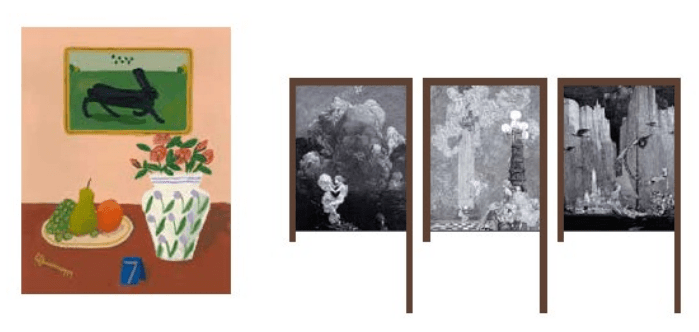
Franklin Booth, a native of Carmel, Indiana, earned widespread recognition as “the finest pen-and-ink artist in America” during his career. His intricately detailed drawings exhibit a unique style, born from his early attempts to mimic wood engravings using pen and ink – a technique that became his signature. Booth’s illustrations graced the works of Indiana’s beloved poet, James Whitcomb Riley, as well as various local and national newspapers and magazines, further cementing his artistic legacy. As seen in this trio of unconventionally framed reproduction art prints, the striking contrast
between monumental landscapes and minuscule figures in his work evokes a subtle sense of surrealism.
FRAMING INSPIRATION
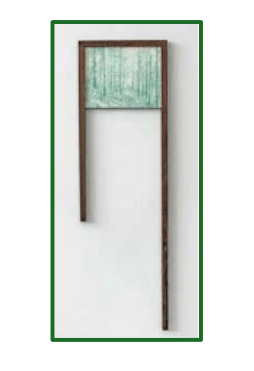
Embracing an unexpected framing concept, this design seamlessly integrates asymmetry as its primary feature. With three sides enclosed, the bottom remains open, creating a light airy feel. Notably, one side is intentionally shorter than the other, inviting a moment of reflection and echoing the unique vibe of other artworks within the hotel.
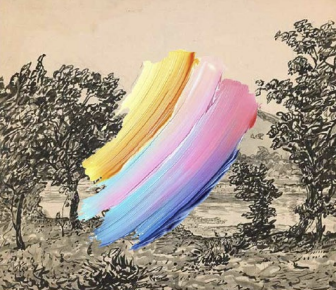
This drawing, titled Butler’s Hill, Brookville by John Ottis Adams, is housed in the collection at the Indianapolis Museum of Art. What begins as a simple sketch is transformed into a vibrant and contemporary work of art through the addition of a colorful brush stroke by local artist Quincy Owens. The interplay of grayscale lines against the sost swath of color creates a striking new image, showcasing Adams’s skill in traditional techniques infused with imaginative flair.
Lobby

As of early 2024, Indiana’s whitetail deer population was estimated to be around 700,000. Unlike traditional taxidermy, this striking deer wall art is crasted entirely from natural mahogany and poplar woods laser cut to create the shapes. A distinctive and nature-inspired feature in the lobby adds depth and dimension to the fabulous tile for a rich, organic aesthetic and speaks to the pink deer head in the restaurant.
Prefunction
The Prefunction space is filled with fun, colorful, graphic, unexpected imagery that highlights the fabulous furniture and provides unexpected surprises for guests of the Tallison. Consisting of prints alongside originals, many of the pieces reference architecture and are inspired by the work of historical art figures and movements. Some reference the outdoors and local landscapes.

An aerial photo of one of Carmel’s most notable figure 8 roundabouts dons this wall in the prefunction area. A filter was added to make it resemble an abstract painting. Carmel, Indiana, is known as the “Roundabout Capital of the United States” with over 150 roundabouts, which have been instrumental in improving traffic flow, safety, and overall community benefits. Carmel’s
roundabout network has been credited with a significant reduction in accidents, including injury accidents, by about 80% and overall accidents by about 40%. The city has also reduced vehicular emissions and improved air quality. Additionally, roundabouts have made it easier for pedestrians and bicyclists to navigate the city.
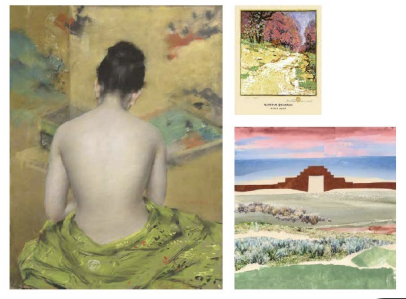
Notable Features:
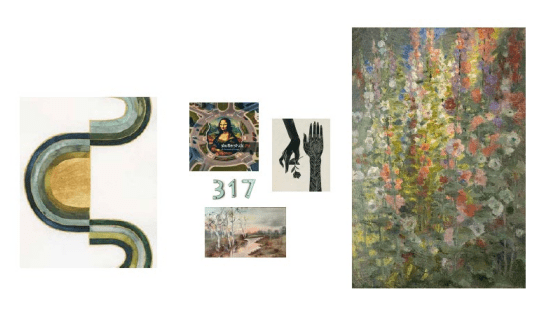
- An 1888 painting titled Study of Flesh Color and Gold by renowned Indiana painter William Merritt Chase.
- A vintage poster with artwork by Gustave Baumann, a well-known artist who was part of the early 20th century Brown County arts community and a friend of TC Steele (pictured in the Ballroom)
- Funky artwork with a reference to the Prairie and Frank Lloyd Wright’s home and studio, Taliesin
Notable Features:
- An AI generated image of a roundabout featuring the Mona Lisa in the center, playfully poking fun at one of Carmel’s most prominent characteristics. The prompt was: Create an image showing how Leonardo Da Vinci would design a roundabout.
- Hoosier helping hands – “Hoosier” is one of Indiana’s oldest nicknames and is generally used in a positive way to describe friendliness, neighborliness, and contentment with life in Indiana.
- A lovely original Indiana landscape watercolor featuring trees and a stream resembling the White River, which runs through Carmel and Indianapolis. It is signed and appears to be dated 1934. The painting is mounted in an authentic vintage wood picture frame.
- Ceramic numbers depicting the local area code.
- A spectacular painting titled Hollyhocks by Otto Stark, one of the Hoosier Group of artists pictured in the ballroom corridor – the original is housed in the Indiana State Museum.
Notable Features:
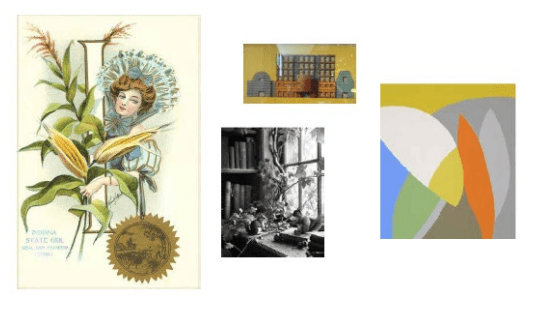
- A vintage Indiana State Fair poster featuring a blue bonnet belle with corn.
- A vintage drawing by Michael Graves, a world-renowned architect from Indianapolis.
- An unexpected image of squirrels, which run playfully rampant both in Carmel and across Indiana.
- A painting by Felrath Hines, an important Indiana artist and member of the Black Abstractionism canon, which refers to a modern arts movement celebrating black artists.
Courtyard Corridor
In the Courtyard Corridor, fun funky imagery is juxtaposed and elevated by an occasional original.
Notable Features:
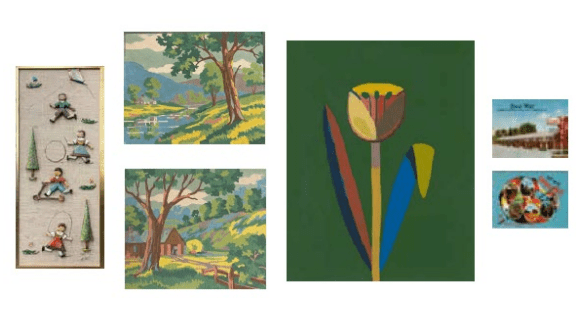
- A vintage wall hanging showcasing wood reliefs of children playing.
- A pair of vintage paint-by-number artworks evocative of southern Indiana farm scenes.
- Vintage postcards of the Carmel Motel (which is funny and ironic) and an expression of Indianapolis art inspiration.
- While not a direct representation of Indiana’s state tree, the tulip tree, this geometric painting of a tulip was too captivating to pass up for The Tallison.
Notable Features:
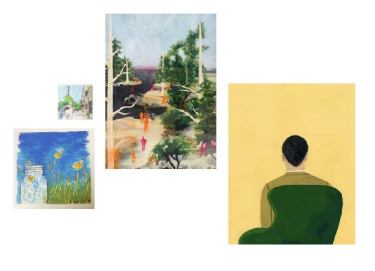
- An illustration of the Carmel kissing statue on Main Street by local artist, Skye Lee Smith.
- A Ball jar illustration as a nod to the Ball Brothers Glass Manufacturing Company, incorporated in Indiana in 1886 – the artist drew it on her child’s lunch napkin as a way of saying I love you in the middle of the day.
- Funky artwork with reference to Indiana landscapes and rivers.
- An Edward Hopper-esque painting of a gentleman seated with his back to the viewer—uncannily reminiscent of The Tallison’s first general manager—has come to embody Adam’s presence within the hotel’s story.
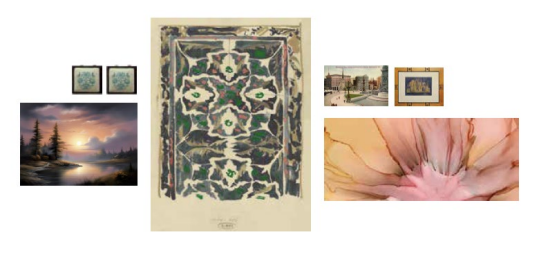
Notable Features:
- Two needlepoints from a vintage sewing box.
- An AI generated painting inspired by Indiana native Bob Ross.
- A rug sketch with reference to the Arts and Crasts period.
- A vintage copper etching of a scene from the Indiana Dunes.
- An artistic homage to the peony, Indiana’s state flower.
Ballroom Corridor
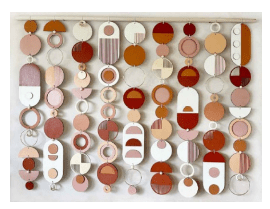
Gracing each end of the ballroom corridor, two distinctive masterpieces engage in a silent dialogue of color and form. The graceful elliptical shapes on this curtain-like assemblage piece resonate with the elegant arches and barrel vaults found in the Rafael painting at the other end of the ballroom corridor. Meanwhile, the circle motif, a recurring symbol throughout the hotel, pays homage to the Circle City and the city of Carmel’s infamous roundabouts. Frank Lloyd Wright’s iconic Cheroke Red boldly contrasts with soft russet tones, delicately softened by hues of mauve, coral, and cream.
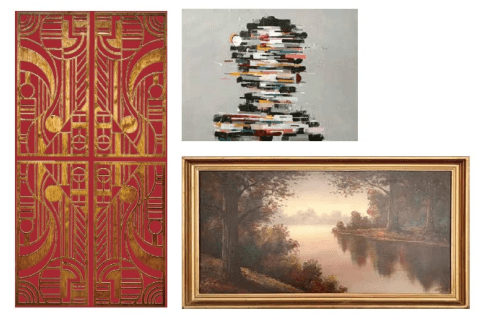
Notable Features:
- A decorative pierced wood wall sculpture referencing Frank Lloyd Wright’s stained glass windows by Carmel artist, Steve Cheslock
- A vintage Indiana landscape painting by 20th century artist, Lorenz Griffith
- A funky abstract portrait rounds out this collection with color, geometry and contrast and whimsy

In this painting titled, The Art Jury by Wayman Adams, members of the turn-of-the-century Hoosier Group, known for their impressionist style, peer into the future, offering their critique of the lively and imaginative world that awaits in Robert Indiana’s iconic LOVE sculpture. Both works are prominent features of the Indianapolis Museum of Art’s Indiana Artist collection.
[Left to right: T. C. Steele, Otto Stark, John Ottis Adams and William Forsyth]
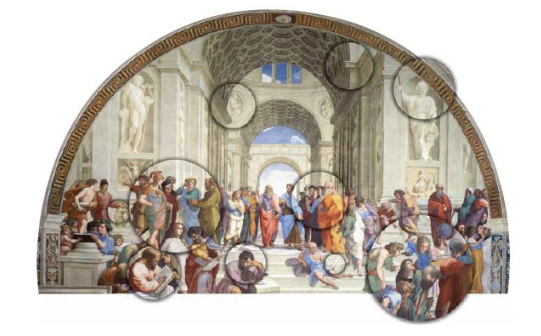
At the Prefunction end, architecture takes center stage in this homage to the Renaissance by 16th-century Italian artist Raphael, titled School of Athens. The original fresco features a celebrated assembly of philosophers, artists, and thinkers. Beneath barrel vaults and marble sculptures, Plato and Aristotle engage in a discourse symbolizing the philosophical debate between ideas and forms, a widely interpreted aspect of their ideologies. Acrylic “bubbles” overlay the image, magnifying intriguing scenes and encouraging closer reflection. This contemporary interpretation, created exclusively for the Tallison Hotel, invites viewers to engage with the artwork on multiple levels — whether reflecting on its layered symbolism or capturing a photo-worthy Instagram moment.
Elevator Lobbies

The image selections here loosely reference master artists and important moments in art history.
1st FLOOR: Ancient Greek and Roman sculpture.
2nd FLOOR: Faith Ringold.
3rd FLOOR: Henri Matisse.
4th FLOOR: Alfred Stieglitz.
5th FLOOR: Nick Cave.
6th FLOOR: Amedeo Modigilani.
The elevator lobby pieces are showcased in a playful and distinctive manner, encouraging viewers to take a closer look as they await the elevator. Vintage-style frames, mounted directly onto the paintings rather than around them, infuse the space with intrigue and whimsical charm.
Navigate back to the main menu.
The Tallison – a Tribute Portfolio hotel by Marriott
 The Tallison Hotel
You must be logged in to post a comment.